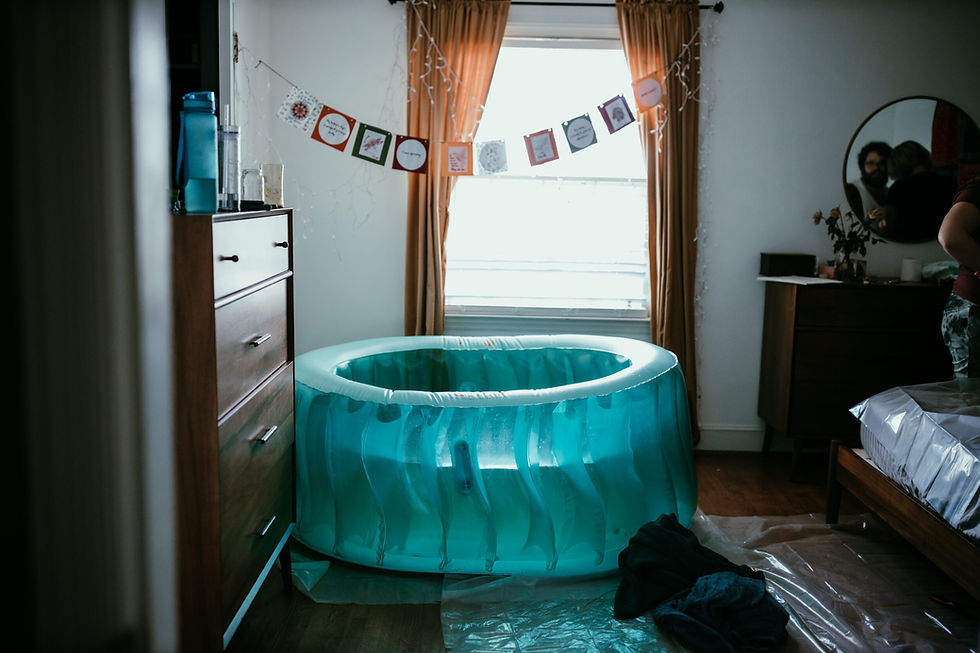
.png)


Laboring Through the Labyrinth: A Birth Story about Rolling with the Punches


This is Roxanne's story, in her own words:
My husband and I started seriously talking about having a baby in 2020 during the pandemic. The first time we conceived ended in a pregnancy loss in 2023. I didn’t have any bleeding or anything, but when I went to the first appointment, they didn’t find a heartbeat. It made me realize how little I actually knew about the process. I was shocked that I had been living in my body for 33 years and didn’t know something like that could happen, and how difficult it is to get pregnant.
We found out we were pregnant again almost exactly a year later, in March of 2024. Milo’s first eight- or ten-week appointment was actually almost the same day as the first pregnancy’s. So that felt a little surreal. It was a happy time, but it felt a little more cautious, more humble than the first time. The whole pregnancy was pretty smooth, no complications or anything, but the early appointments were nerve-wracking. I was definitely in denial for a while that I was pregnant. I noticed I was referring to Milo as “it” until over halfway through the pregnancy. I think I was trying to keep a little distance just in case something went wrong again. But at around 16 weeks, when I heard the heartbeat for the first time, that was a big moment for me.
We ended up with a midwife practice at Northwestern. We had decided on a hospital birth pretty early on. My husband and I felt that if anything happened to the baby or to me, we’d want to be in the hospital. I actually landed in the midwife practice by accident because they didn’t have any OBs available soon enough. But I’m really glad it worked out that way, because it ended up being a great fit. And the birth classes we took at Chicago Picnic were really helpful for me. I remember there was this one activity we did during one of the last classes where we laid out cards representing different aspects of our ideal birth, and they would have us turn them over and choose a few to remove. It was a really engaging way to understand that you have no control over how your birth goes. You might come into it hoping for a certain type of birth, but it might just not be in the cards for you.
When we were interviewing doulas, one of the reasons we chose Mel was because they said something like, “I can’t guarantee the birth you want, but I can help you move through the process so you walk away satisfied with the decisions you made in the moment,” which really resonated with me. It felt like a radical acceptance of how little control you have that didn’t compromise any agency.
The Birth:
I wanted a spontaneous birth and I wanted to labor at home. Especially after the birth classes, I felt strongly about that. We had even read that dogs can be really great early labor companions. I was also preparing mentally and physically for an unmedicated birth and doing pelvic floor physical therapy, which was definitely helpful and something I still recommend every pregnant person to do. Milo ended up being late, and after around 37 or 38 weeks, the midwives were really pushing me to do an induction, but I really, really didn’t want that. It was weird to me because the midwives had seemed really crunchy and knowledgeable, but then many ended up being as pushy as they could be for an induction. It was a really stressful time and my anxiety was high. But ultimately, we decided I should wait.
The weekend Milo was born, it was unseasonably warm for November. We had been going on lots of hikes, and one day we saw a blue heron. Blue herons have always been a big omen for me in my life. It was just standing on the side of the river so we just stood and watched it for a long time. And just the next day, we saw a coyote and some deer looking at each other. The coyote didn’t feel threatening, they were both just trying to figure each other out. It felt really symbolic, though I’m still trying to figure out what exactly it meant.

That night, I felt a little “pop-pop” and like a spark in my abdomen. I had just lain down to go to sleep and when I went to the bathroom, there was all this brownish, murky water. It kept coming out and I panicked for a second. My water had broken. It was exactly like everyone says, it was this “Oh my God, what do I do?” moment. But Mel and Leila, our postpartum doula, and the birth classes prepared us really well. We called the midwife line and Brian was texting with Mel. The brown meant there was meconium in my water, so they recommended coming in within the hour.
I remember this moment really vividly. I was standing in the bathroom, thinking about the idea that birth is like a “labyrinth,” which I had learned from the book Transformed by Birth. You can move in all of these different directions, but you don’t really know how to get to the center of the labyrinth. You just kind of have to go through it to get there. I thought, All right, this is the beginning of the labyrinth. We don’t have control over a lot of things; we can only respond to what is in front of us at that moment. The labyrinth was one of the most important things that got me through the whole process of the birth.
We called Mel, and what I love about Mel is that they are always super grounded and chill. They don’t come till you’re in active labor, but they reminded and reassured me that I could still labor at home if I wanted, but the hospital was going to really push us to go in for fetal monitoring. My husband and I were nervous that there might be something wrong with the baby, because he was already a week late and there was meconium in the water, so we decided to go in at around 10:30 at night.
When we got to triage, they assumed we were staying for labor, so I had to clarify that we were just there to check on things and then make a decision. Working with Mel and our birth classes really prepared us to advocate for ourselves. They taught us that unless it’s a serious emergency, you can always buy more time. Unless they’re saying you need to do this right now for the safety of the baby, you can always say, hey, can you step out so we can talk about this and make a decision?
It took around two hours before the midwife came. So it was around 2 a.m. when the midwife finally said that the baby looked fine, but the presence of meconium can make things more risky. It was late and we were already in the room, and I knew my anxiety would be higher if we went back home and waited, so we decided to stay.
That felt like the first big decision. And then the midwife was also recommending an “augmented labor," which is basically an induction. And that had been the one thing I didn’t want. But I had gotten my spontaneous water breaking, so I tried to choose the slowest, most gentle method possible, which was an oral medication [misoprostol]. It started a couple hours of very difficult labor. I don’t remember much, not even the quality or intensity of the pain. But there was a point where it was really bad. It had been hours and it felt like things were going really slowly. I was really tired. They offered me narcotics so I could rest and I decided to take them. If labor is like a marathon, then when you’re running a marathon, you take breaks. For me the point is to finish the marathon, not to run the whole time. I took them and took the best nap of my life for an hour.
Then my contractions started again and they were really tough. Brian was excellent. He brought some snacks and lights and I had a playlist going. I had both a “chill” playlist and a “pump up” playlist. And it was helpful to have some materialistic things from home. I brought pillows and I had this stuffed animal that had rice in it so you could warm it up in the microwave and I ended up using that. I did a lot of moving, a lot of swaying and verbalization of the pain, just making sounds, but most of that’s a blur. I had a couple of mantras in my phone: “This will pass” was a big one. So was “tenderness and strength.” And Brian being there, saying things like “you got this” and “you’re so strong.” But sometimes I’d also be like, “Brian, I don’t need you to say anything,” and he’d be like, “Okay.” I think having him be really flexible was super important. Also, laughing and making jokes about things and having this normal banter between contractions with him was also helpful. Especially during the Pitocin contractions, because I didn’t get that endorphin kick. From what I’ve heard about spontaneous labor, the contractions themselves are gnarly, but you get into this kind of rhythmic, “animal” zone, and I never got there.
When things got bad, I tried the shower, which was sort of the last comfort measure we hadn’t tried yet. And it helped, but not enough. For the first few hours of the labor, the pain was unpredictable, but it still felt like something I could ride through. At that point, it felt really different. I was at 6 centimeters and it felt like I was at another point in the labyrinth where we would have to make another decision. Do I get an epidural? I hadn’t wanted an epidural because I wanted full autonomy during labor, I wanted to be able to move around. But I realized I might have a birth experience closer to what I’d imagined if I got the epidural than if I didn’t. So I got one.
After that, things weren’t smooth exactly, because it would still be a long time before I gave birth to Milo, but it was the next part of the labyrinth. I had just gotten the epidural, Mel arrived, and we hung out for a few hours, which was really nice. My cervix started expanding but the baby was positioned weirdly. I don’t remember if he was sunny-side up or what, but we were trying to get him to move. I lay over a peanut ball on my hands and knees for like an hour. And Mel and I tried all of these different positions to try to get him to turn. My epidural actually allowed me to get back on the train and feel like I was able to work through the labor again.
It’s all really hazy, but at some point, I had a cervical lip. They explained that it’s like a turtleneck when part of the turtleneck is stuck and won’t come up. At that point, the baby’s vitals were hard to pick up on the monitor and the medical team wanted to get moving and have me do other interventions to help me give birth. Northwestern has this agenda of just getting pregnant people and babies through quickly, but Mel was really great at advocating for alternatives to more medical interventions. They stood there with me and held the baby monitor on my stomach so I could keep trying more positions to see if that would work. Eventually, the lip had dissolved enough for the midwife to push it back and then I was fully dilated. Mel was saying that they were glad that I had gotten the epidural because it can be painful to have your cervical lip manually pushed back.
I pushed for about an hour and it felt really empowering. It was early morning, 3 or 4 a.m., the next day, so my labor at this point had been around 30 hours. They rotate midwives and I got a younger midwife, who was really wonderful and was training, so there was another midwife there to supervise. So I got two midwives at my birth and they both worked well with Mel.
I was pushing for a while on my back, but I think I ended up giving birth on my side, with one leg up. At some point, the older midwife was saying, because it had been a long labor, “If this baby doesn’t come soon, we’re going to need to use forceps or possibly consider a C-section.” At that moment, I was like, “Fuck no, I am not doing that.” So it was then that I really dug my heels in and was like, we’re getting this baby out. I did reach that transition point, where I remember I turned to Mel and was like, “I can’t do this.” But then I got to touch Milo’s head, and they brought over a mirror so I could see him, so that was really motivating. I was able to see that progress and see him come out.
After that, Milo was born, and they put him on my stomach and chest, but he wasn’t breathing, so they brought in the pediatric team. His APGAR score wasn’t great and they put him in the baby warmer. This part is really busy in my mind. I delivered the placenta, but they thought they felt something else in there, another piece of placenta or a fibroid. And then they were stitching me up. All this was happening with me while they were still working on Milo.
Eventually, he started crying and I remember hearing some murmurs from him over there. But then they took him upstairs to the NICU. This part is still very difficult for me to talk about. The plan was if anything happened with the baby, Brian would go with the baby, so he left with Milo.
The wild thing was that there had been this flurry of activity, but then everyone leaves and the room is empty. It was just me, a nurse and Mel. I don’t even know how long I was there, but it had to be a couple of hours. It felt pretty traumatic. The way I cope with immediate trauma is that I try to stay as logical-minded as possible. So I remember having a super normal conversation with Mel, and they were like, “Are you in shock?” I was so glad that I had opted for a doula at that moment because Mel could stay there with me. We finally got the thumbs up that Milo was stable; he had just had a hard transition coming out, which sometimes happens when you’re on an SSRI like I was. Brian and Mel were texting the whole time so I could get videos and check-ins. Mel also gave a lot of really helpful advice, like you should do whatever it takes to get your baby stable, out of the NICU and home as soon as possible.
NICU Reflections:
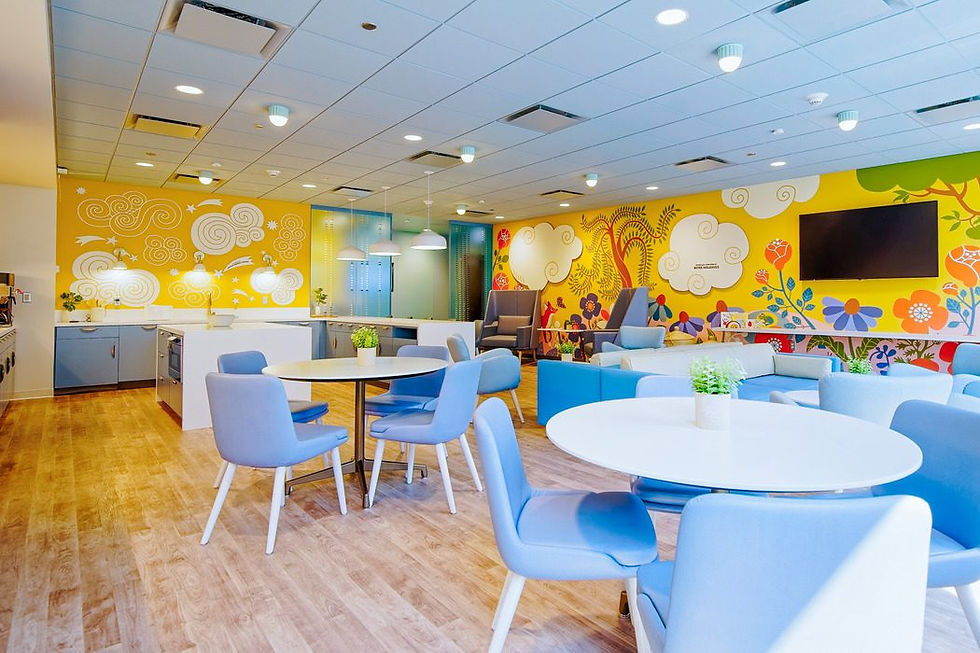
We stayed in the NICU for five days. Milo had swallowed a lot of fluid and was having trouble latching. He ended up having a tongue tie release because his little tongue was heart-shaped. I look back at the experience as both traumatic and empowering. As crazy as it might sound, I don’t think I would change anything because the care we received in the NICU was out of this world. Brian and I don’t have a lot of family around or support in that way. One of the things Mel said before they left was that the universe gives you the labor you need. In the last couple years, I’ve become a big believer in the universe and not that good things happen to good people or bad things happen to bad people, but the universe will give you things and it’s up to you to sort of step back and see what it’s trying to teach you. Mel was like, maybe the universe is giving you extra care right now because it’s teaching you to accept help, that you can’t do this alone.
I kept calling the NICU “baby boot camp” because we learned so much about caring for Milo in those few days. We were able to stay in this lounge right by the NICU, so we could stay close to him the whole time. Our neighbors were able to care for our dog, even though we weren’t expecting to be in the hospital that long.
Humor was really important when we were staying in the NICU. The lounge had a kitchen and living room for families to stay, and we ended up staying overnight there, but you weren’t really supposed to bring outside food into the room, but Brian had found a way to smuggle stuff in. I was in a wheelchair for a few days after giving birth so Brian and I would race down the hallway with him pushing me, which you’re definitely not supposed to do at a hospital. There was also this moment that was really funny. We were sitting in the lounge on like day 2 or 3 after I gave birth, when suddenly I remembered we had a fish at home we had forgotten to feed and I was like, “Fuck! Glenn!”
When we did finally get home, we already knew how to do so many things. It felt so alien, though, to come home after all of that. But we worked with Leila, our postpartum doula and that was an incredible experience. Leila came a couple of times a week for two weeks to help and support us with everything.
Postpartum Reflections:
Mel and I talked about how labor really only gets you to the center of the labyrinth, to the birth, but the postpartum period is really about finding your way out again. I remember that was really helpful in grounding me and being like, “alright, this is where we’re at.”
I’ve been on a journey with my body through this whole experience, that’s been another big part of it. I grew up with a lot of body dysmorphia and a lot of fat phobia from within my family, but I wasn’t really labeling it until now, into my adulthood. Throughout the pregnancy, I was surprised at how much I was able to embrace my body and then through the labor, I felt really strong and in awe of how my body could do all of these amazing things. My body needed some help through it, but that was okay. The pelvic floor therapy I had done had helped me gain a lot of confidence in understanding how my pelvic floor worked, which I didn’t know at all before.
Afterwards has been a different story. It was easier for me to have an appreciation for my body when I was growing Milo because it was doing a very specific task. But after giving birth, it was harder to have that same sort of self-compassion for my body, and that’s still an ongoing journey. The physical changes have been hard. My weight fluctuated quite a bit to the point where none of my clothes fit.
It’s been a lot of hard stuff I wasn’t anticipating. I even had to get my gallbladder removed because I had these really bad gas pains while I was pregnant that continued postpartum, which ended up being gallstones. Apparently, because of the increased estrogen and cholesterol, gallstones can be a common side effect of pregnancy. And having my gallbladder removed put me again into this pseudo postpartum period, where I was bedridden again. I had a lot of respect for my body, but I was not able to move my body in ways that I had before.
And feeding was something I don’t think was gonna have as much of an impact on how I viewed my body, but it really did. Within the last few weeks, I’ve actually stopped breastfeeding and pumping, so you’re catching me at this time postpartum where I am adjusting to no longer feeding him from my body anymore. I’ve realized how numb I’ve been to my body and physical sensations. But I have stretch marks on my stomach that I’ve come to love, because I am proud that I can point to that and say that’s where I grew my baby. Scars don’t have to be bad; they’re a nice reminder that I was Milo’s first home.
In the first few weeks, Milo felt very much like something that needed to be kept alive. Yes, he was very cute, but it felt mostly like a lot of “okay, so how do we take care of you?” My mom passed away six weeks after I gave birth and that in itself impacted my relationship with Milo and is something I’m still working through. Sometimes I feel like a mom, but sometimes I don’t and it can feel like, “what am I doing?” But I think my mom's passing has made me really latch onto parenting Milo and trying to be as present and grounded as possible in my moments with him. I have this one memory of rocking him in the nursery, he was so small, cute and like snarfly and making all of these little noises. I was having a delayed response to my mom's passing, but I was able to find some solace in that moment.